

These Subscriber Q&A’s are available for all to read (you can read Part 1 here), but if you find this interesting and would like access to all previous and future articles, please consider a paid subscription. Thank you as always for the support!
A random question on your player impact model - do all bookings get assessed the same way? Do some have a positive and others a negative impact on player’s assessed performance?
In short, yes all bookings and red cards do get assessed in the same way. The question is entirely legitimate though as there are obviously some fouls and cards that are essentially good decisions to stop promising attacks.
Unfortunately, without tracking data (which is not publicly available and very expensive to get access to), it is very difficult (at least in my opinion) to measure the positive or negative impact associated with a booking in an accurate enough way.
I could assign different values depending on what has happened directly before a yellow card (i.e. has the opposition just created a turnover and therefore beginning a counter attack), but when all I have to hand is the location of the events without the very important context of where players are located, what passing angles are on offer at the time of the foul and whether players are running into space or not, I don’t think I can accurately ‘grade’ a foul or yellow card.
I am continually tweaking the Player Impact Model as time goes by, as I gradually introduce new metrics or player measures that I think can help compliment the eye test with performance based on data. A couple of years ago I wrote a more in depth piece on it for the great guys at the Analysts Bar - you can read more about that here.
I am interested in your scouting processes,particularly on how you use data to make decisions.
I could go on forever about how I use my data to identify players and make decisions, but I’ll try to cut it down into smaller stages.
Identify exactly what I’m looking for
Let’s take a more recent example and think about Elliot Anderson leaving Forest - I wrote a few pieces on some potential targets, but in order to get to that point I needed to initially work out exactly what I was looking for.
In this case, I felt Forest would most likely be looking at players who hit the following criteria:
At least one season of full playing experience in a top European league
An age where Forest could reasonably expect a good resale value after the initial investment (I looked mostly for under 25s)
Have a data profile that covers at least one of Anderson’s key strengths - mainly ball-winning and progression.
There’s more that goes in to that stage, but that will give you an initial idea of how I’d get to a very long list of players.
Remove players who are unrealistic targets
This would mainly compromise of a player hitting a red flag - usually either a player that would cost a significant amount of money to prize them away (think Alex Scott at Bournemouth), or a player who has very recently signed a new contract with their club.
Other things may come in to play too - perhaps other ‘bigger’ teams have already shown an interest that would make the chances of Forest getting involved very slim, or perhaps that team has no pressure to sell because they’ve already made a big sale (like Forest themselves), or because they’ve qualified for the Champions League and would likely want to play in that competition.
Look deeper into the overall data profile & player history
This could be included in the 2nd stage really, but it is just the way I do things in general. Now I’d be looking at a player’s history - are they injured often? If so, is that because they’ve had a couple of big injuries, or do they just constantly miss games because of knocks and sprains.
I’d also be looking at a midfielder’s possession profile alongside their defensive one. For example, it’s great if a player is a turnover machine, but not too useful if they struggle to keep possession after regaining it. On the other side of the ball, it’s great if a player is a real goal threat, but are their defensive numbers at least passable? If not, is that because they’re playing for a team that doesn’t do much defending, or is it because they just don’t get involved?
Those are two reasons why I’d discount a player in this scenario - with the added context of what team they’re playing for and what their opposition looks like.
Look into action areas - are these targets used to operating in similar areas of the field?
This would usually be the last part of my process when it comes to filtering out with the data, as I’ll now start to also look at some clips if possible. I gave an example recently on X where I spoke about the similar data profiles of Nico Dominguez & Joelinton.
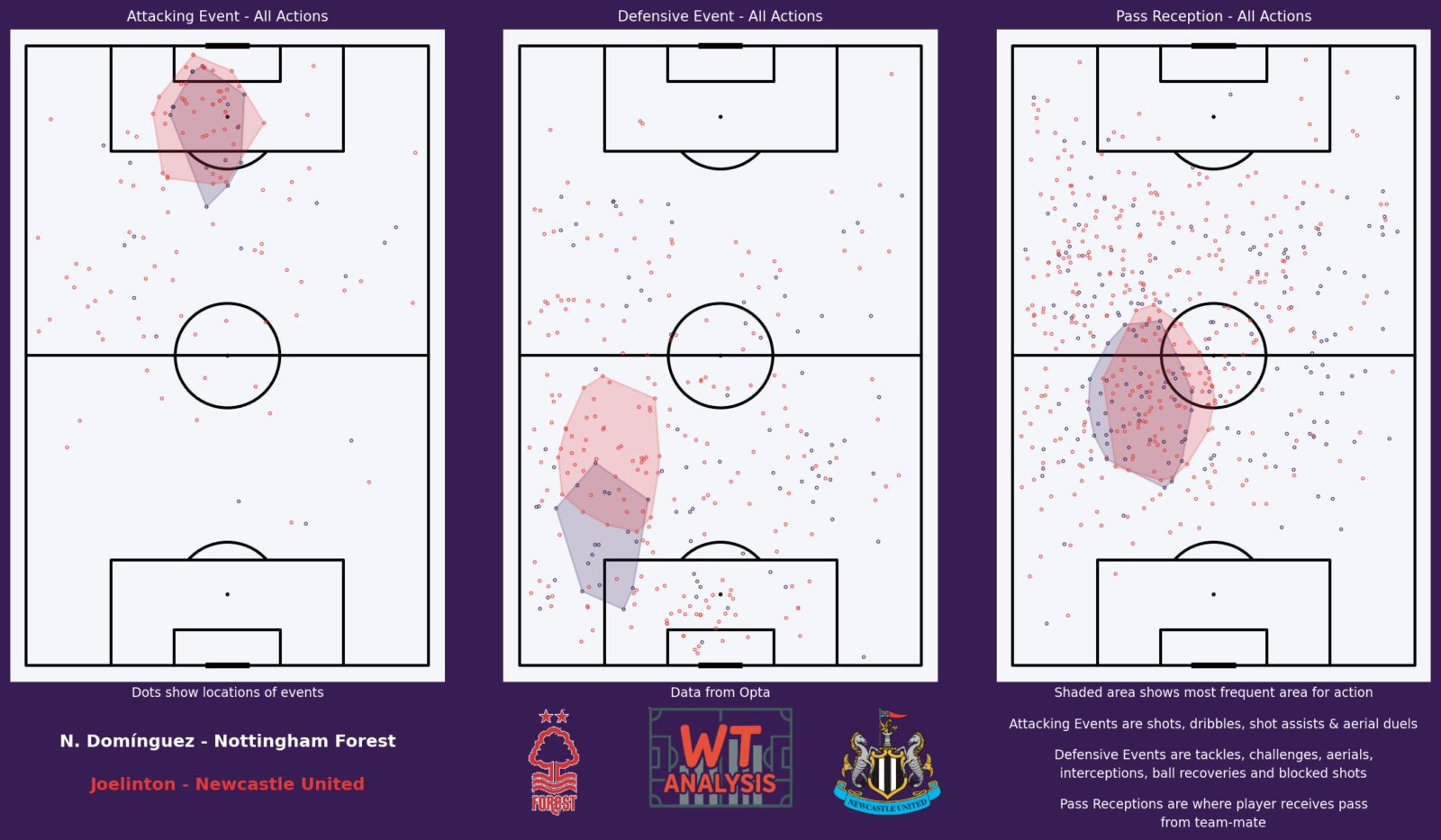
This was off the back of a question around comparing players in a midfield 2 and a midfield 3. Pretend you don’t know anything about these two players, and that you’ve never watched them before. The data tells us that they operate in similar areas of the field despite playing in different systems.
This would suggest initially at least that if Forest were trying to replace Dominguez, that Joelinton might be a good fit. We of course know that they are not really the same player, but the data work would probably have Joelinton in the final list.
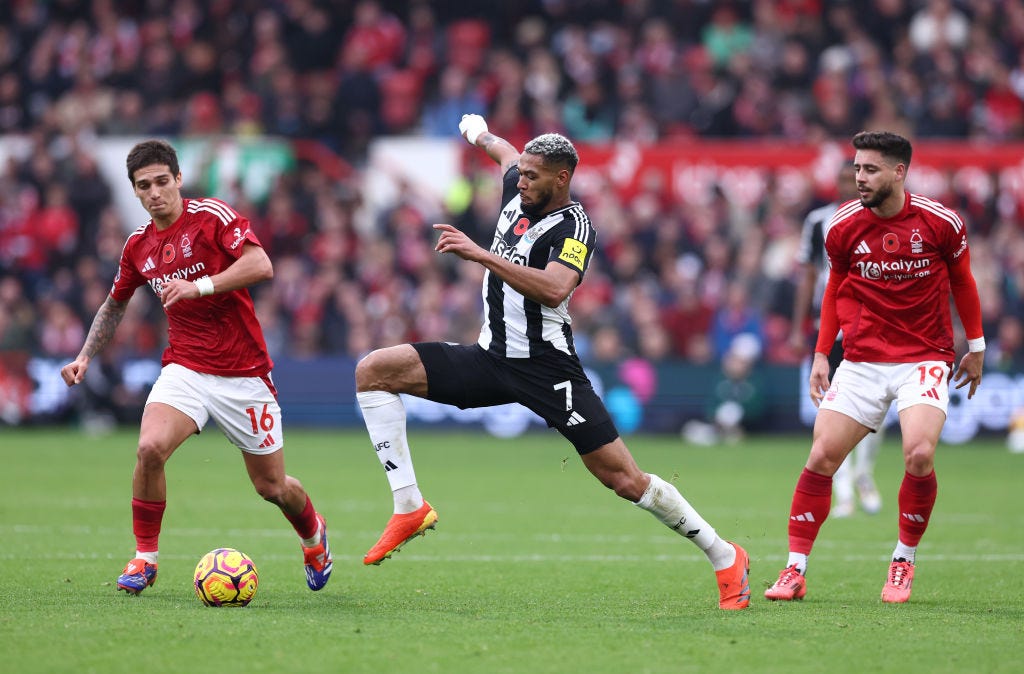
It’s a great example of why I keep banging the drum around data not giving us the full picture, and why before giving my full opinion on a player that Forest are linked with I like to make sure I’ve watched them play a bit first. You’ll see the difference in my posts because I’ll normally call them Scout Reports when my analysis includes watching footage of them.
With my final list, use the eye test to remove players that don’t fit
Although this isn’t part of the data process, it’s important just to note that there’s a final stage after I’ve gone through the data before I’ll make a decision on whether to include a player in my final iteration of a short list.
In my most recent posts around Elliot Anderson replacements, there were a combination of players who I’d looked at after they popped up in the data, with some others that I’d included after a bit of viewing too.
As I mentioned above, I do think it’s important to be clear when speaking about players and separate out both opinions - it’s one of the reasons why I and many other people working in and around the game don’t like the very simplistic visuals you’ll see from accounts like Data MB, that are essentially just radar charts with no added context whatsoever. They can be very misleading and give a wrong impression about a player very easily.
What’s been the biggest change in using data since you started?
My journey in football data is around 3 years old now - and there’s lots of things that have changed in that time period - mostly for the better, but on occassion for the worst.
Focussing on the bad initially, it can be very difficult to get hold of football data from reliable sources at reasonable cost. Wyscout was my primary source of data, and even back then it was over £400 a year just for data access.
It’s coverage was and still is unrivalled, they pretty much have every league in the world (Men’s & Women’s), with history going back around 10 seasons. The platform is fairly easy to use and navigate, however they are a business and they know they have a control on the market.
Because of this, they’ve increased prices dramatically in recent years, to the point where last summer I made the difficult decision to stop renewing my subscription, as from memory they were asking for over £700 for the same access I had in the previous year.
Other publicly available sites - particuarly FB Ref - were great sources but it seems lost the licences to provide that on their website. It still exists on other sites, but FB Ref easily had the best free online platform for many leagues across the world.
On the other hand though, there are so many great free resources that people have created to try and fill the gaps. Some of them you will require a little bit of coding knowledge to make the most of them, others (like my Player Data Dashboard) are tools that can be used by anybody on a laptop or mobile phone.
The online football analytics community is almost always a very helpful and useful one to engage in, there’s lots of people who share ideas and knowledge to help others grow and create new things.
There’s been some great advancements in dashboards in recent years too, including Twelve Football’s Earpiece app, and a couple of Ben Griffis’ apps too for player data and match reports. These are all free to use, and there’s plenty of other innovative ones out there too if you look for them.
Away from dashboards, as time goes on there’s more and more interesting and useful metrics being created. Just using my own work as an example, I’ve redone a lot of my code to include data splits by game state, to include possession chains, or even something as simple as the most common location for actions.
Almost everything someone creates in the football analysis space is off the back of someone else’s idea - this isn’t a bad thing as often this is taking a great piece of work to another level. It seems to me like the work being done by clubs & individuals is enhancing all the time, and it can sometimes be a bit of a trouble to keep up!
Do you feel that certain attributes/data metrics are becoming more important for clubs when scouting, considering how the game is evolving?
I think this is definitely the case, but the specific attributes and metrics will be different for every club, and even for agencies who use data heavily to try and attract clients for them to represent.
I’d wager that most clubs in the Premier League & Championship will now have a data science department, clubs are taking the value of data in football far more seriously than they ever used to - in part due to the success of teams like Brentford & Brighton in recent seasons.
With virtually every league in the world covered by data providers these days, I don’t think there would be a player who joins a Championship or Premier League club this summer where a team like Forest won’t at least be aware of them.

It would be wrong of me to speak and speculate on specific attributes and metrics - but it is almost a certainty that most clubs in the Premier League will be creating their own in-house metrics to evaluate players, even if the original data source may well be the same.
What I find most interesting about the availability of data for worldwide leagues, is how English clubs are using the foreign markets in many different ways. You can read more about that on the GBE Expert Hub, where Andy gives a great overview on who might or might not be eligible to make a move to England, and what they would need to accomplish to change that.
What’s the biggest thing you’ve learned working directly with clubs?
There’s obviously a limit to what I can share here, but I can give an overview of my experiences over the past year or so. There is an incredible amount of planning that goes into each transfer window, never mind each signing,
All clubs will work in different ways, and some of them will get a lot of stick for a lack of business (just as Forest are this summer), but a lot of the hard work around identifying a list of players for different positions will already have been done.

When Forest were first linked with Ousmane Diomande a couple of weeks ago, it was mentioned in the report that they had been tracking him for some time. Sometimes we read that in just think “yeah of course they were” and not really believe it - but the reality is this is most likely true, because Forest will have been (and still will be) tracking a whole host of centre back options - Diomande will just happen to be pretty high in that long list.
In fact, with the club’s resources not just at the Nigel Doughty Academy but also in at Rio Ave & Olympiacos, Forest will have a long list for every single position, and they’ll keep tabs on those players for long periods of time so that they’re aware of potential options.
For me, my biggest learnings have come from remembering how important all the work scouts do is - regardless of the outcome. It is just as important for a scout to say ‘no this player is not for us’, as it is to say ‘I think we should look at this guy’.
As an aspiring analyst what puts a candidate to the front of the line when hiring for an actual role at a club?
The first thing I’d recommend for anybody interested in getting into a career in football, is to create some form of social media presence. The work social media companies to to create algorithms so users see things that resonate with them, is very much your friend in this situation.
Before you do that though, you should decide upon what you want your niche to be - what are you going to do that separates you out from the crowd. For me, I initially focussed on Forest as well as Notts County & Mansfield Town, all teams I knew fairly well, and being local I had a decent feel for their strenghts & weaknesses too.
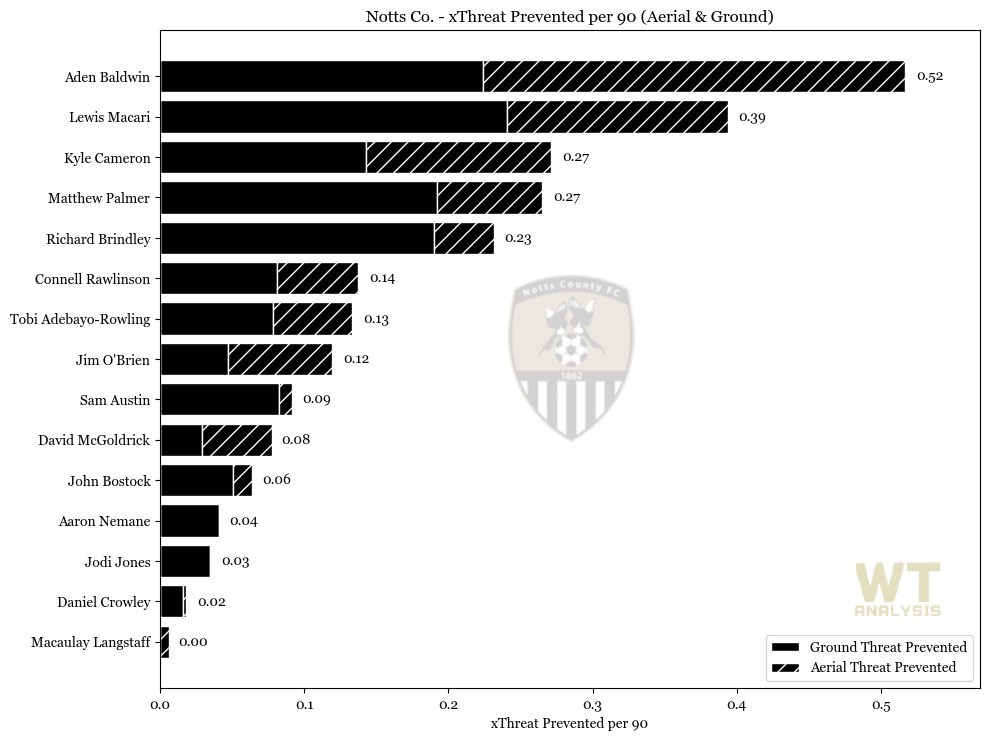
I would produce short pieces on potential targets for all 3 clubs - I’d post visuals on performances in individual matches. Over time I built a small following where people would come to me for opinions on all 3 clubs.
This gradually got me noticed by players, clubs & agencies. I was fortunate enough to do some small pieces of data work for individuals, giving me some important experience.
During this initial period, I continued to improve my coding skills - something that I think at the time was essential to continue improving my work - now it is far easier as you can ask AI for help on the code very quickly.
I then decided after a season to focus solely on Forest - dedicating all of my time and energy in this space to the club. I was then fortunate enough to be invited to The Recruitment Room ran by Liam Henshaw, a community of people who all want to work in the game and have varying experience in doing so.

It was in that community - which is full of mentors and people who work at clubs - where I came across the opportunity to work for Barrow, and then later for Motherwell. I was fortunate in this regard to be in the right place at the right time, but also believe I worked really hard to get into that position to be fortunate.
For me, being a consistent presence in your area of expertise will get you noticed. When applying for jobs, you’ll often be given tasks to perform to assess your suitability - don’t be afraid to ask around for help, don’t be afraid to make connections and ask questions. Football is a very hard business to get in to, and just like me you’ll likely get knocked back on many occassions.
In general I have always believed that good things do come to those that deserve them - for sure though when it comes to working in football it will take longer for some than it does for others. My best advice is to keep going, keep improving and keep producing informative work that will get noticed by someone who just might be able to give you an opportunity.
What a guy!
Nice insight Will. How do analysts gel with ex-footballers who are scouts in your experience? Have you discussed that aspect with your fellow Forest Focus associate, James Perch?