

This article was written before the international break - Sato reportedly had an injury issue and missed the first game against Scotland, before being an unused sub against England at Wembley.
At just 19 years old, Ryūnosuke Satō is one of the brightest talents the J-League has to offer, and after a great spell on loan in 2025, he’s back at his parent club ready to build on his first full season in senior football, potentially with a view to being part of Japan’s World Cup squad.
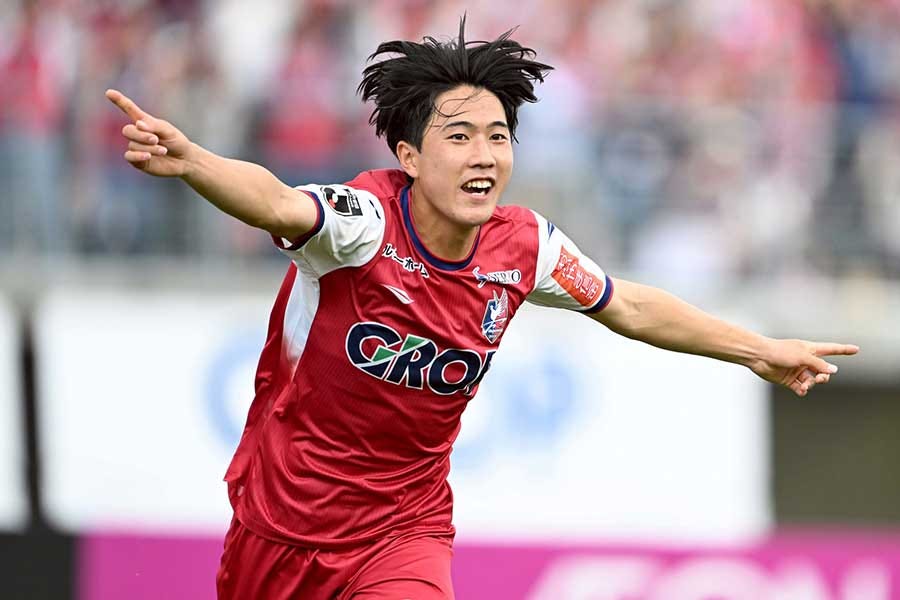
The biggest question mark on Satō at this stage of his fledgling career is what position he’ll play in. Last season he split his time playing as a wing-back on either side, but many feel his future perhaps lies in a more central role.
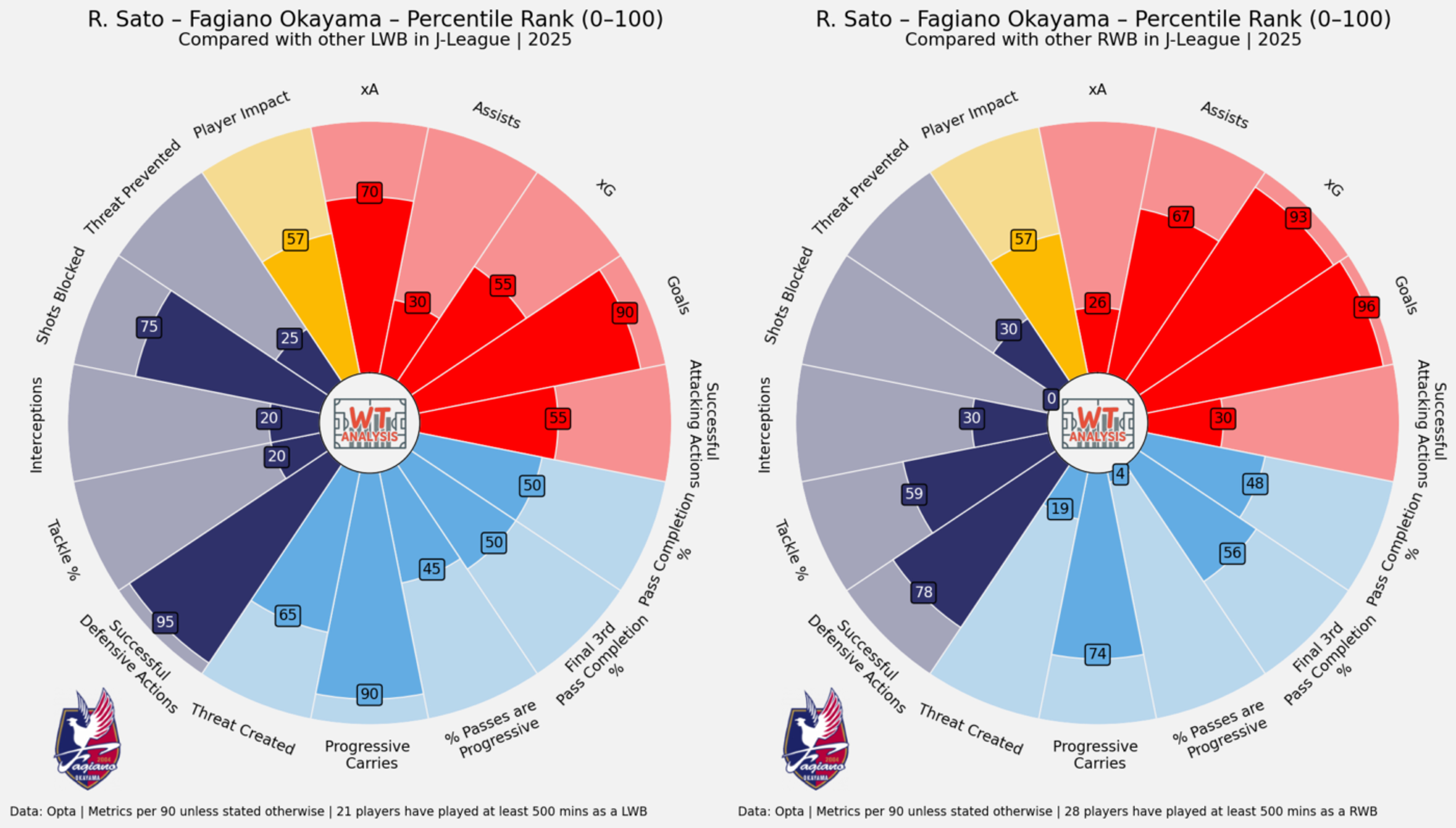
With Fagiano Okayama last season, Satō spent just under 1,200 minutes as a LWB, and just under 900 minutes as a RWB. We can see from his data on both flanks though that his impact & playing style remains fairly consistent regardless of which side of the field he’s situated.
In the early stages of this season he’s spent most of his time on the left flank with FC Tokyo, so it’s that side of the pitch we’ll concentrate on here.
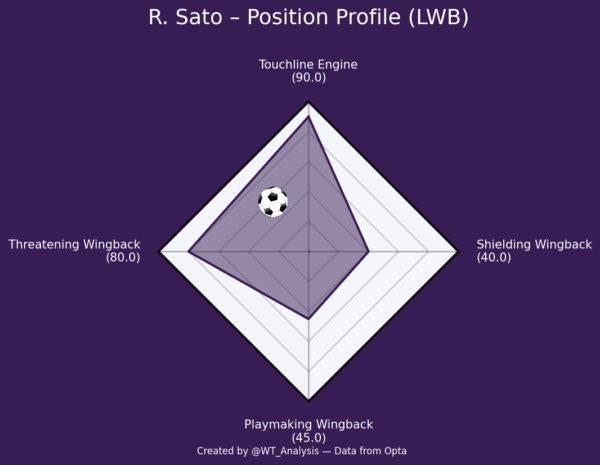
His data profile suggests Satō was a wing-back that threatens the opposition box, with a work rate that allows him to participate at both ends of the pitch. This is shown most obviously when looking at his Successful Defensive Actions per 90, where he ranked in the 95th percentile last season.
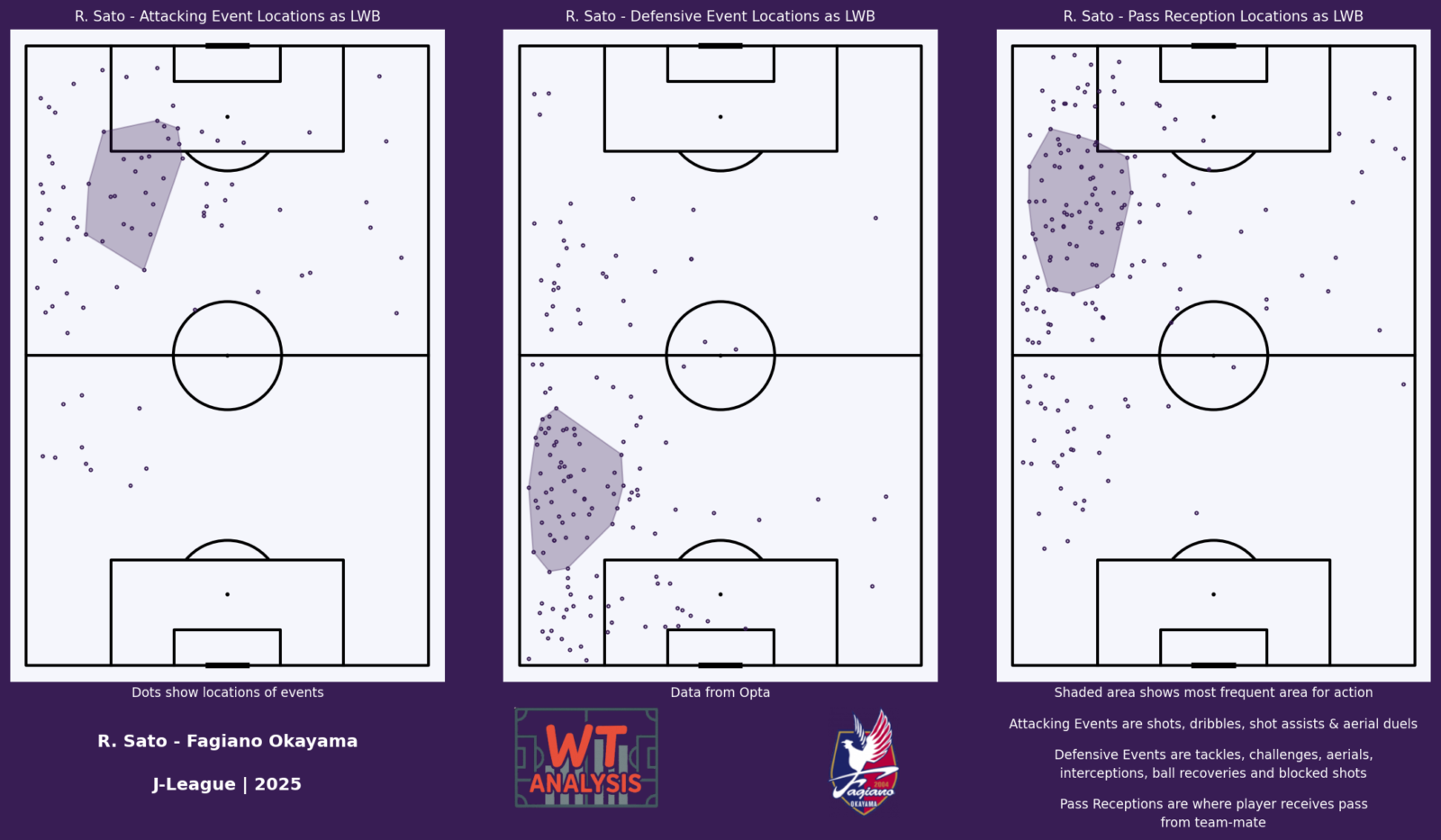
What I speak about above translates perfectly into this visual - his attacking events are narrower than you would expect a traditional wing-back to be, his pass reception locations are generally very high up the field, and he has a significant amount of defensive actions inside his own final third.
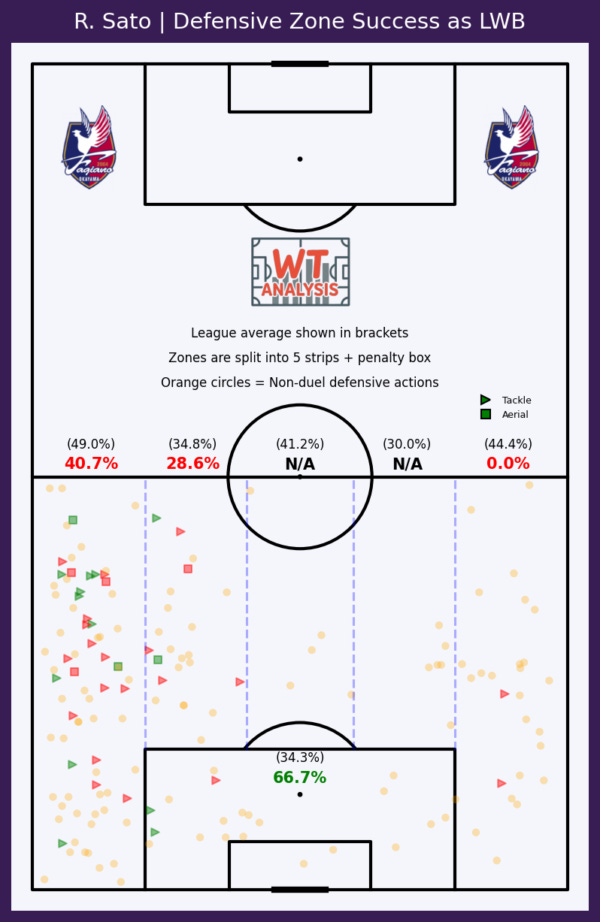
Like most young players - especially ones with an attacking profile like Satō - his main weakness defensively is his success rate in duels. Despite having lots of successful defensive actions, his tackle success is just 50% overall. Combine this with aerial duels (he’s only 5”7), and his duel success is just 40.7% when wide on the left.
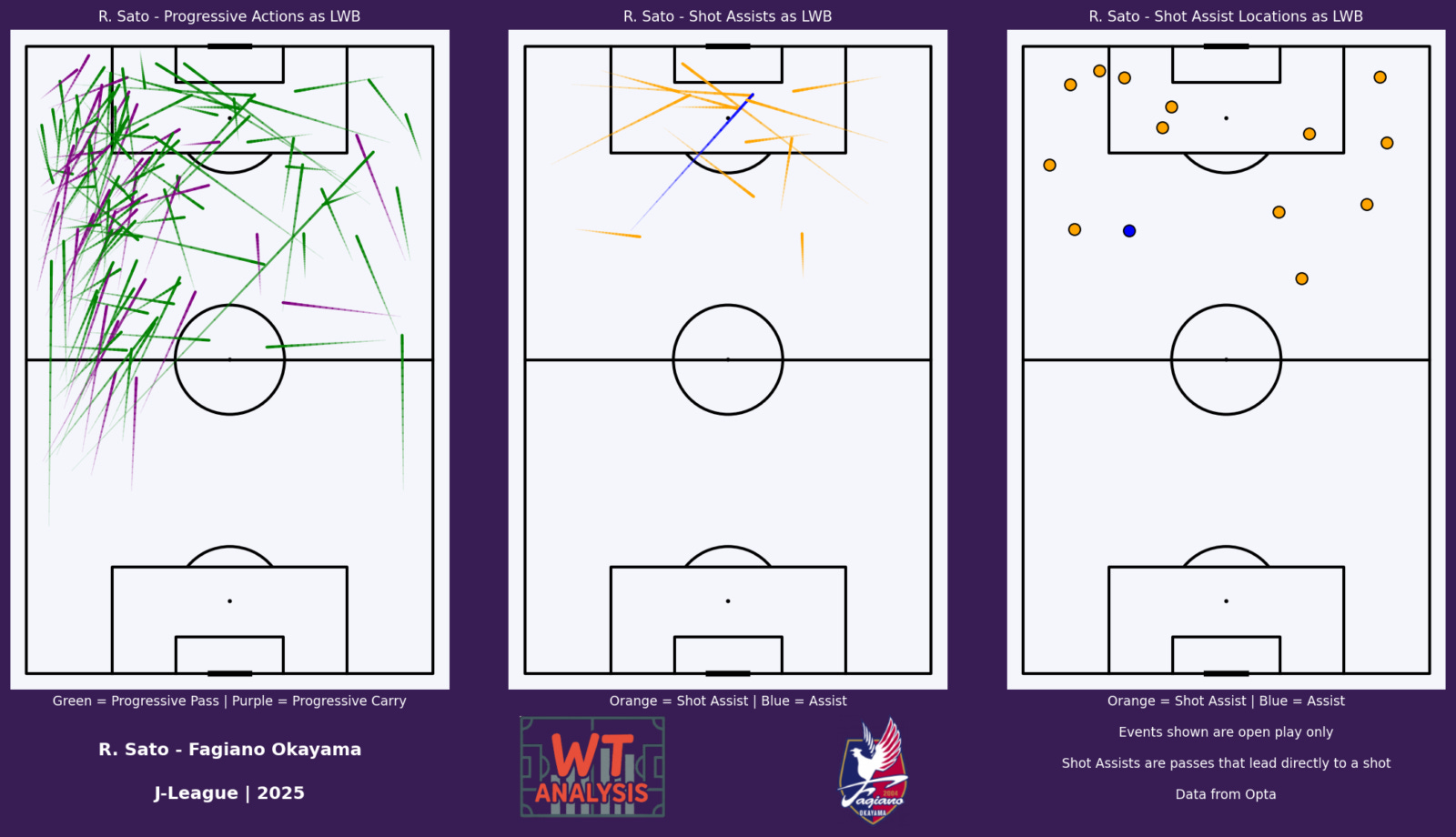
The biggest difference between Satō’s profile on the left and the right, is his ability to progress the ball. His ball carrying numbers remain high from both sides (although are higher on the left), but as a right footer when he’s playing on the left he finds it much easier to find good passing angles to progress the ball into more dangerous areas.
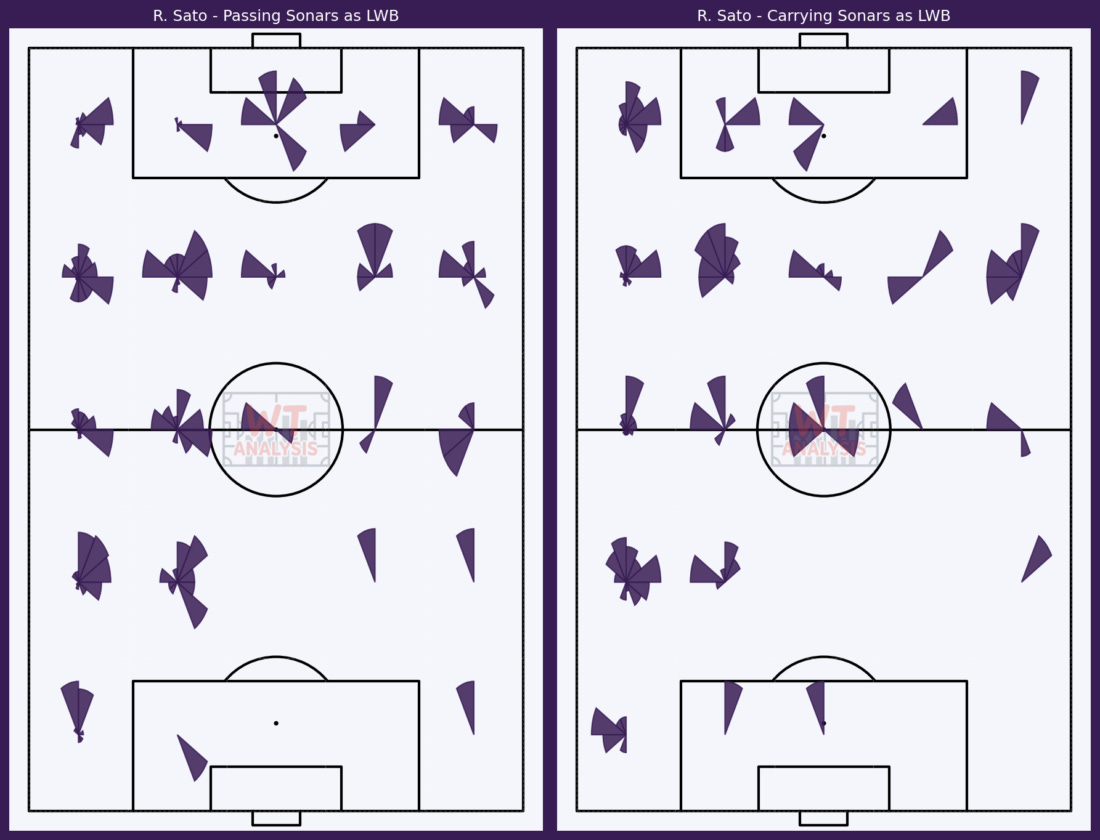
If you gave Satō the ball on the left last season, he might pass the ball backwards on occasion, or more likely sideways - but if you allow him to carry the ball from within the middle third then he will pretty much always carry it forward.
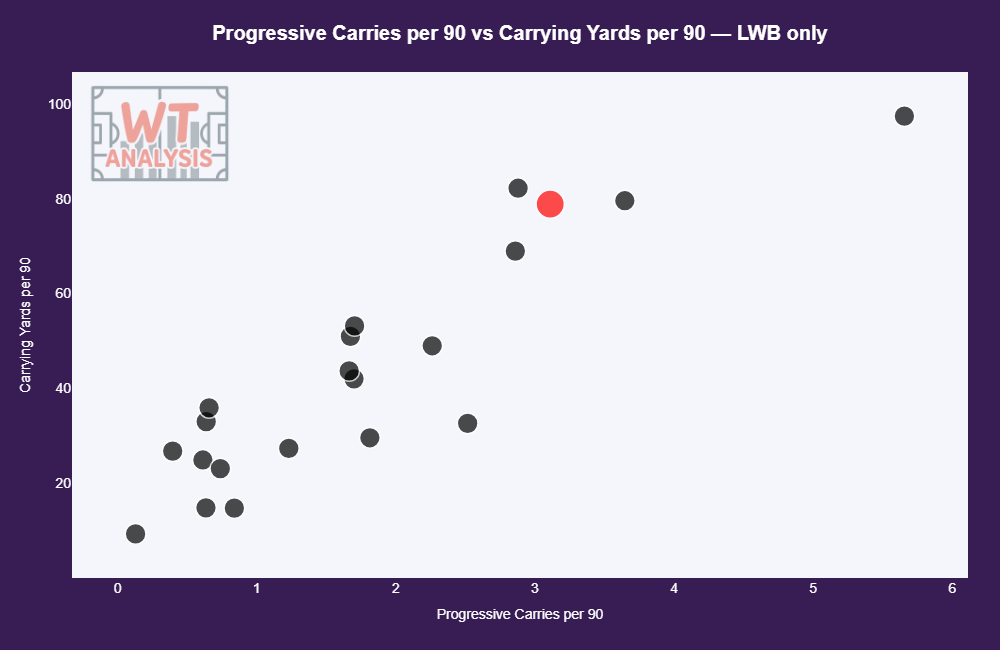
Only 2 players at left-wing back had more Progressive Carries per 90 than Satō last season, and only 3 had more net Carrying Yards per 90. These are great numbers for someone so young, and go a long way to explain why there’s such a buzz about him and also why he’s already got 5 senior caps for his country.
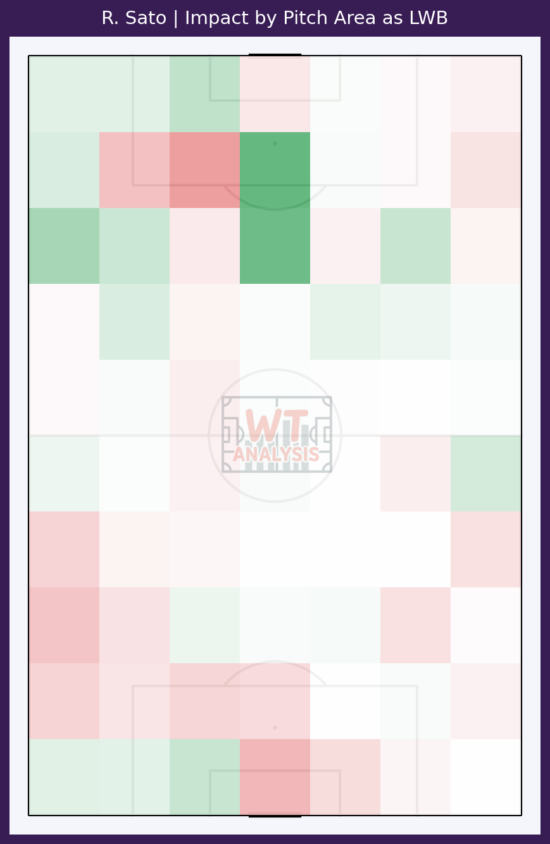
The last visual to look at shows where he’s having the greatest impact for his team compared to his peers at left wing-back. His poor defensive duel success means there’s a lot of light red in his own final third - but ahead of that in the opposition half it looks very positive.
With time this could of course change, Satō is essentially only 1 year into his senior career and at 19 still has a lot of growing to do both physically and mentally. But it also explains why, as mentioned above, some feel his future may best lie centrally and/or higher up the field.
In fact he has been doing just that for FC Tokyo in the early stages of this season, playing mostly on the left of midfield in a 4-4-2 system. This comes after an encouraging AFC U23 Championships with Japan in January where he notched 3 goals and 2 assists playing as the number 10 in a 4-2-3-1.
Clips & Highlights
In a recent game against Yokohama F Marinos, Sato scored his first goal for FC Tokyo in a first half that blew away the opposition. Throughout the game he pressed with intensity, this lead to him deflecting a pass that gained his side possession of the ball.
Sato then maintains his wide position, making himself available for a ball down the left. It looks a little awkward but he manages to control the ball before confidently cutting inside onto his right foot. He strikes the ball well through the defenders legs and aims for the near side of the goal - the goalkeeper although perhaps unsighted, should do better. Either way, Sato scored a nice goal that was reward for his good initial work.
It was noticeable in the game that Sato was able to pop up in central areas despite playing on the left wing. This happened a lot more in the second half - for a 19 year old he showed some really intelligent moments where he would drop into good spaces to receive the ball, but before doing so he’d regularly check his shoulders for opponents and passing options.
Physically, for me he fights above his size, although because he’s quite small in stature and still so young he can be physically overpowered at times. This can come with time and experience though. The above video shows each of his actions in the 3-0 victory, before being subbed off in the 2nd half.
This highlights video is from last year, where he played as an 18 year old for Fagiano Okayama. Throughout he shows some really good touches and moments, and an awareness that many his age just do not show.
Final Thoughts
Last year was Sato’s breakthrough, in his first full season as a senior pro with significant playing time, he was the Young Player of the Month twice and eventually the overall J-League Young Player of the Year. This led to him breaking into the senior national side in June 2025, and he now has 5 caps to his name.
Sato will be hoping to make the final World Cup squad for Japan this summer, he has a great chance of doing so despite not turning 20 until October. It might not be a tournament where he truly announces himself though, but it’s still an opportunity to put himself on the radar of clubs across Europe.
He still has a lot of growing to both in mind and body. There’s moments where he uses his body well to protect the ball against stronger opponents, but others where he will still be overpowered. This I feel is what could put some teams in the ‘bigger’ leagues from going for him.
Despite playing mostly in wide areas, there are some who feel Sato’s long-term future could be in a more central position - including respected Japanese football writer Ryo Nakagawara, who wrote a great article on Sato on his Substack back in December.
I can definitely see why he thinks that, particularly when we look at those clips above where he shows his ability to drop into those central space to receive passes with his back to defenders. The Japan set up have already utilised him in central areas in the youth teams.
I do wonder though if his intensity in the press (at least at this stage) could mean he would be a bit of a risk playing deeper in a midfield pair though, as he will often leave space in behind him when pressing quick & high - this is something better opponents will expose.
For now, I expect to see Sato remain playing in wider areas where he can continue to gain valuable playing experience at a decent level and in familiar surroundings. It’s possible that any positional change might not come until he makes the next move in his career, which could very well be to a European league.