

This is the first post in a series that will analyse how Glasner will fit at Forest, posts will follow over the next couple of weeks. In this first piece, we’ll look at Glasner’s journey in football, before looking into the numbers around his formations, his squad usage, and general performance.
This piece is free for all to read, to get access to the rest of the deep dive, and all previous posts here on my website, please consider a paid subscription to support my work!
Playing Career
Oliver Glasner’s footballing education was entirely in his homeland of Austria. Born in Salzburg, the now 51 year old moved to Riedau at a very young age, and after a spell with his local side as a youngster, would later join SV Ried - around 20 minutes down the road.
He played 572 times for the club, a number that still remains a club record by over 100. Apart from a 3 game spell with LASK, he played his entire career with SV Ried- and only retired after developing a brain hemorrhage following a training session. The surgery was a success, but he followed the advice of doctors and hung his boots up after 18 years of service.
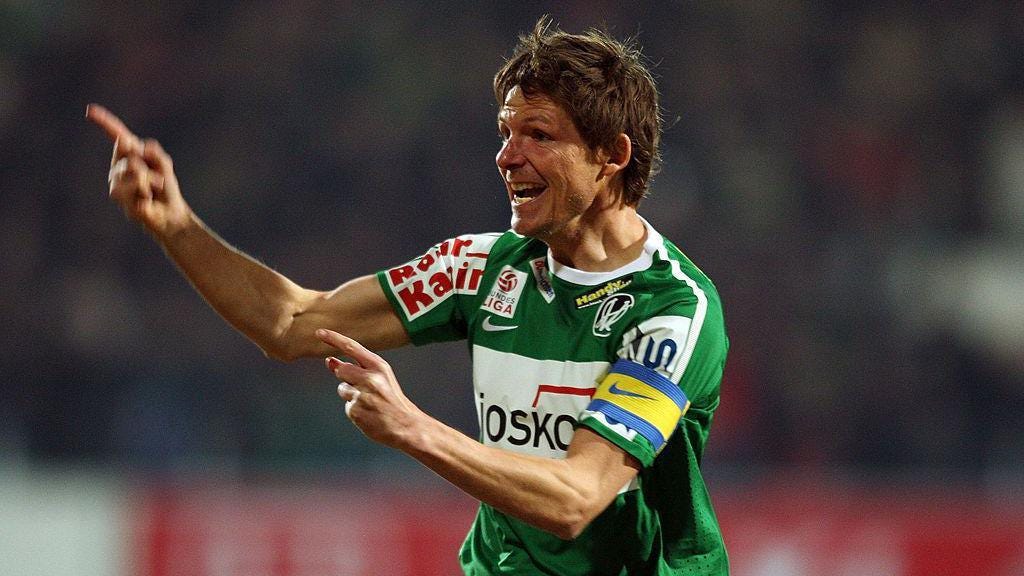
Glasner made 9 appearances for Austria’s U21 side, but was never capped by the senior side. He also made 10 appearances for SV Ried in European Competition, whilst winning 3 domestic cups and the Austrian 2nd Division title.
First Steps Into Coaching
Not long after his retirement from playing, he was offered a coaching role at the side he spent almost his entire career with. However, following a chat with the CEO of Red Bull Salzburg, Peter Vogl (who happened to be an honorary president of SV Ried as well), and joined them as a co-Sporting Director.
It wasn’t long before Ralf Rangnick informed him that they were looking for an assistant coach for the first team squad, where he served under Roger Schmidt for two seasons - finishing on a high as Austrian champions. Schmidt would move to Bayer Leverkusen, but Glasner would remain in Austria and make his first step into management.
Becoming The Main Man in The Dugout
I imagine it came as no surprise to anybody when Oliver Glasner returned to SV Ried in the summer of 2014 to manage the club he played at for so long. He would win his first two games in charge, one in the cup and one in the Austrian top flight - but wouldn’t win another league game until the 10th round.
Interestingly (and something we’ll come on to later), Glasner started his managerial career playing with a back 4. However, to try and turn around his side’s poor run to begin the season, he switched to a back 3 system that he his now well known for - and SV Ried would finish the season comfortably in mid-table - winning 12 & drawing 6 of their 36 games - a 1 point improvement on their performance in the season before Glasner took charge.
He would then make a move down a league to join the other side he made a playing appearance for in LASK. This was perhaps a surprise, but he was reportedly given full control and was named both Director of Football & Head Coach. This maybe gives an insight as to why, since joining English football, Glasner has always been seen to be angling for more control with transfers - something that some media outlets are suggesting he may get at The City Ground.
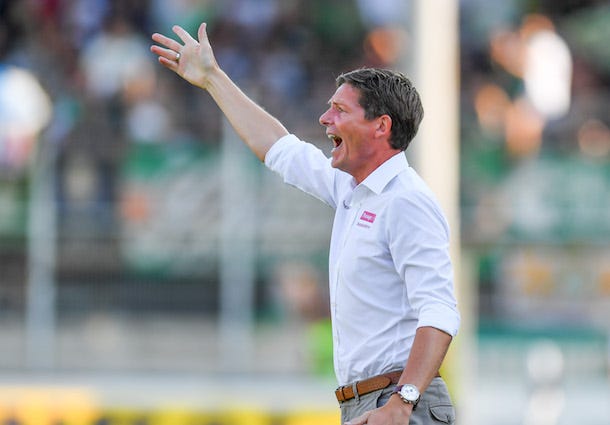
LASK were promoted under Glasner at the second time of asking - as they finished second during his first season in charge before winning the Austrian second tier by 17 points in 2017. Throughout his time in the second tier with LASK - Glasner played with a back 4.
He then lead LASK to an impressive 5th place after promotion, which would allow them to compete in the Europa League Qualifying Rounds in the following season, where they were eventually knocked out by Besiktas despite winning the home leg 2-1. This was perhaps where Glasner first became a huge fan of the back 3, a system he switched to upon promotion to the Austrian Bundesliga and stuck with through the rest of his time at the club.
Glasner would continue to improve his side, as they finished 2nd behind Salzburg - this was LASK’s highest league finish since the 1960s. These performances saw Glasner’s stock rise, and after 4 seasons at the club he would make the move across the border to join Wolfsburg.
The Move To Germany
His introduction to management in Germany was a very positive one - Wolfsburg would remain unbeaten in Glasner’s first 13 games in charge (whilst using a 3-4-3 formation), but a 6-1 defeat in the cup to RB Leipzig rocked the boat a little, and Wolfsburg went on to lose 6 of the next 8 matches.
Glasner then pivoted to a 4-2-3-1 system, variations of which he would use for the remainder of his two-season tenure at the club. During this time, Glasner would guide the club to two consecutive European finishes, including a 4th place finish with 1 game to spare that secured the club a spot in the Champions League.
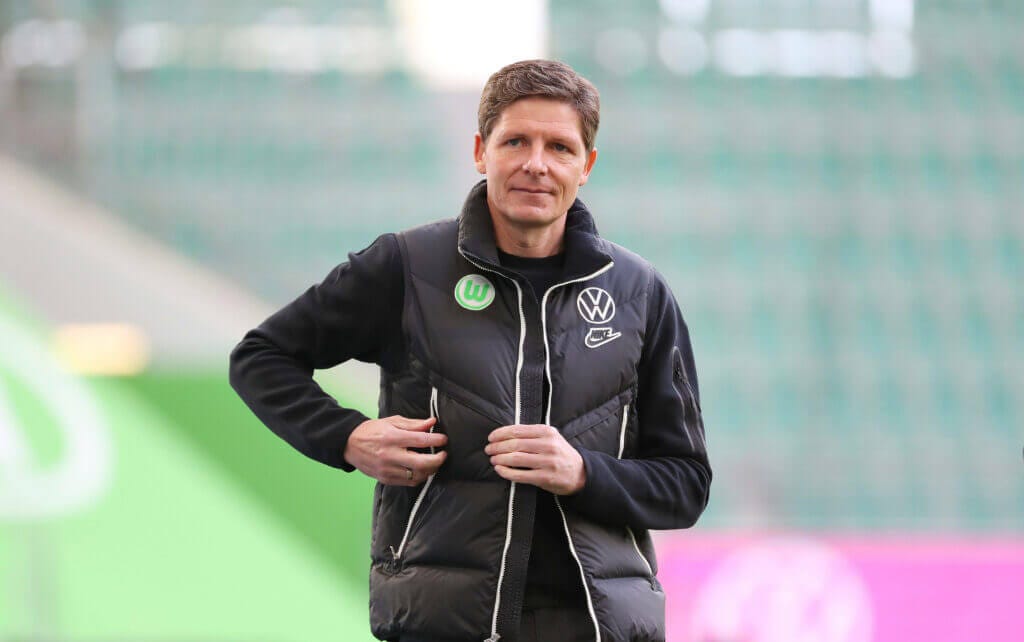
This is when what English football fans will say is perhaps a familiar theme with Glasner (based on recent history at least) arises - despite the success he brought to the club, he departed in the summer of 2021 due to what was described as a poor relationship with his Sporting Director.
It was also reported that his relationship with his players had deteriorated too - with Wolfsburg captain Joshua Guilavogui stating “I’m glad he’s gone” in a media interview. These kinds of stories seem very similar to the noises coming out of Crystal Palace around January of this year. In Glasner’s defence though, further research suggests these were the words of a player who fell down the pecking order in a successful side, rather than those of a player who was truly wronged by his manager.
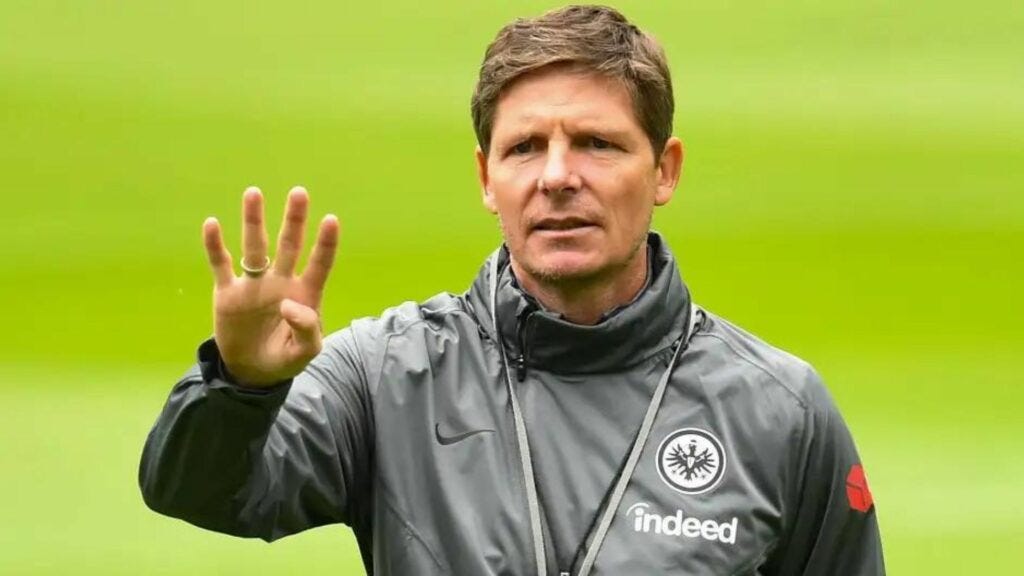
Glasner then moved to Eintracht Frankfurt, and his start there was a bit of a struggle. They lost to third-tier Waldhof Mannheim in the season opening DFB Pokal First Round, and only went on to win just 1 of their first 10 Bundesliga games. Fortunately, along with an unbeaten start in the Europa League, their form would pick up and Glasner would eventually guide his side to a mid-table finish.
Interestingly, Glasner started the season with Frankfurt playing in a back 4 - he felt it necessary to make a switch to the back 3 system that he’d had success with at LASK back in Austria, and outside of a very short spell in 2022, he has remained very loyal to this system ever since.
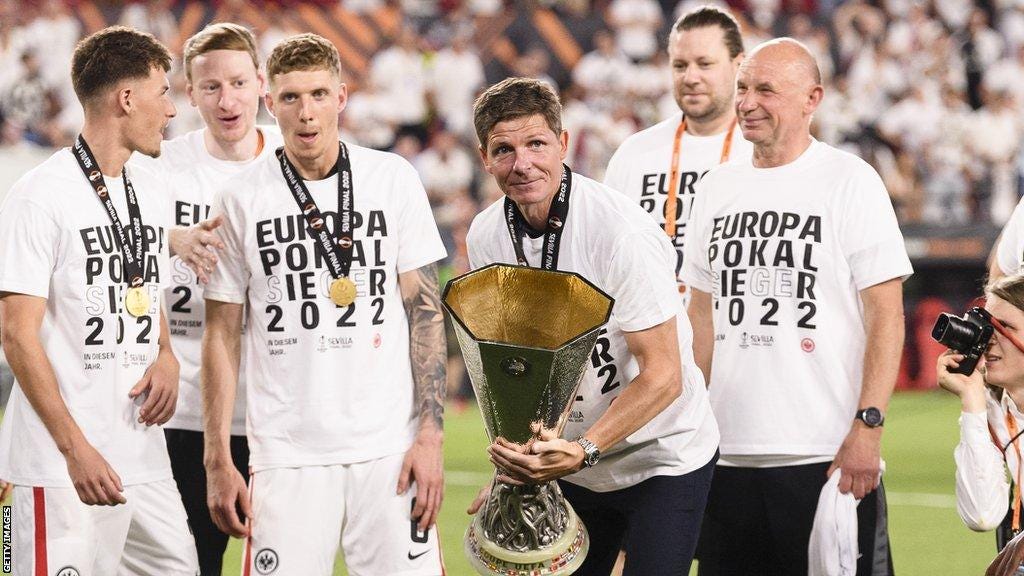
It was during the second half of this season when Glasner’s name started to get noticed across Europe, as he guided Frankfurt to the Europa League trophy with a victory on penalties over Rangers. Impressively, they beat Betis, Barcelona & West Ham on the road to the final - and Frankfurt therefore qualified for the Champions League.
Glasner’s side qualified through the Group Stage of the Champions League, before being knocked out by Napoli in the Round of 16. They also lost in the DFB Pokal Cup Final to RB Leipzig. A run of 10 games without a win during the second half of the season, saw the club fall from 4th to their eventual finishing position of 7th - and Glasner left the club a year before his contract expired.
A Move To The Premier League
After a spell of around 6 months without a job, Oliver Glasner was heavily linked with a move to Nottingham Forest as a likely replacement to Steve Cooper, but as we all know the club eventually went with Nuno Espirito Santo, and Glasner waited a couple more months before replacing Roy Hodgson at Crystal Palace.
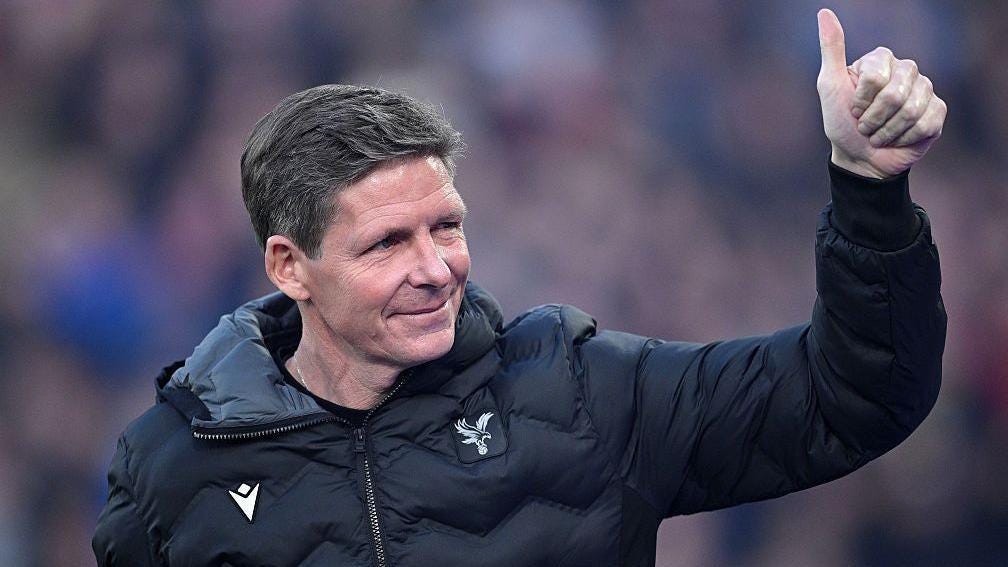
Glasner immediately went for the back 3 system that is synonymous with Crystal Palace - winning his first game against Burnley 3-0, losing just 3 of the final 13 games of the season, and coming up with some statement wins against Man Utd (4-0) and Liverpool (ending their 29 game unbeaten run at Anfield).
There was positivity at Crystal Palace to begin the following season, but Glasner once again struggled to make a good start to a season, failing to win a Premier League game until the 9th attempt. Once they got going though, Palace’s form was strong throughout the rest of the season.
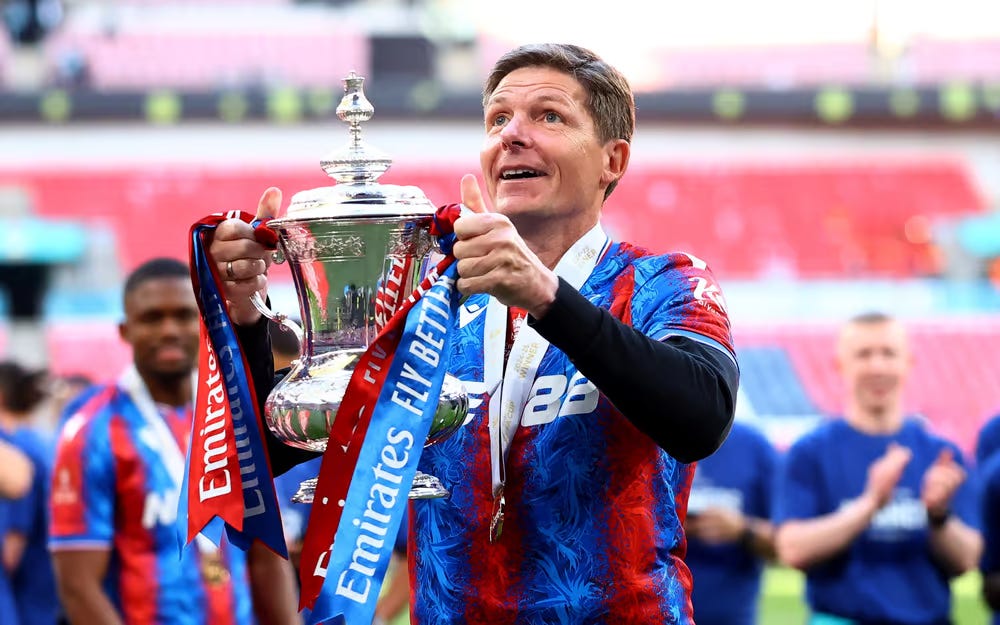
Glasner of course then delivered the best day in Crystal Palace’s history, capitalising on a relatively kind draw to the FA Cup Semi Finals, before dispatching Aston Villa 3-0 and then beating Man City in the final by two goals to nil. This reenforced Glasner’s status as a winner - even though this was essentially only his second top-tier trophy as a manager.
As we as Forest fans are all too familiar with, a tumultuous summer of missed e-mails, court cases & media briefings eventually ended with Crystal Palace’s demotion to the Europa Conference League. Although a bad thing for their finances, this was no doubt a stroke of luck for those fans (and Glasner himself) who had the taste of silverware and wanted some more.
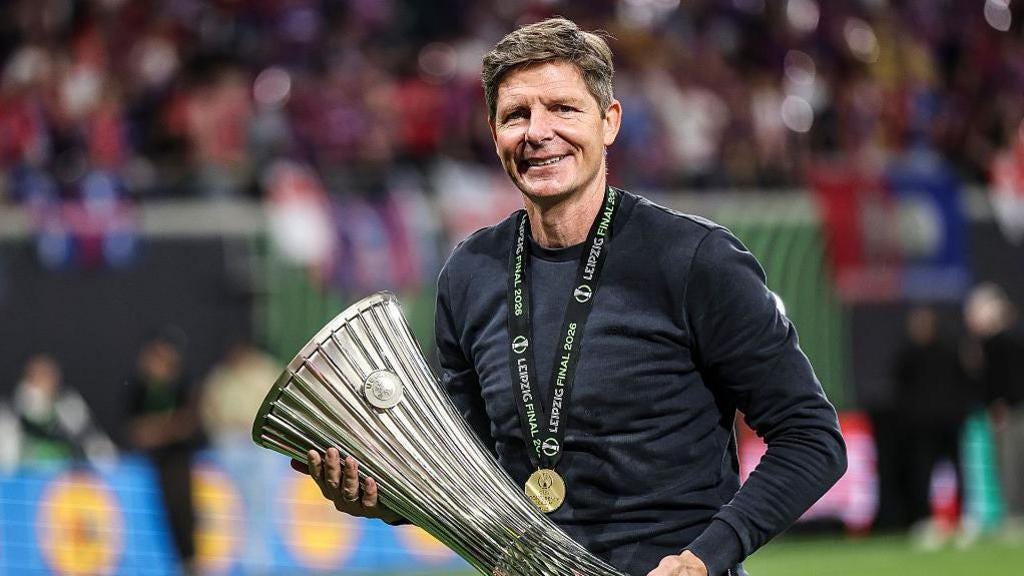
Not only did Crystal Palace return to Wembley last August and win the Community Shield on penalties over Liverpool, they would finish their season with a 3rd trophy in a year with a 1-0 win over Rayo Vallecano in Leipzig (the home of a team who had handed some tough losses to Glasner).
Glasner’s Criticism of Steve Parish
Now we all know that during a very tricky period around January, Glasner became very outspoken and would regularly criticise Steve Parish and the powers that be at Crystal Palace for their inability to retain the value and services of their key players. He also went against the club’s wishes and made public his intention to leave at the end of the season - there was a period of time in early 2026 when it seemed certain that Glasner wouldn’t see out the season, with some players even making noises around everybody needing to remain committed to the club.
Palace of course lost Ebere Eze late in the summer transfer window, and would later lose captain Marc Guehi late in the January window too. Neither of these two players were adequately replaced, leading to this public criticism from Glasner.
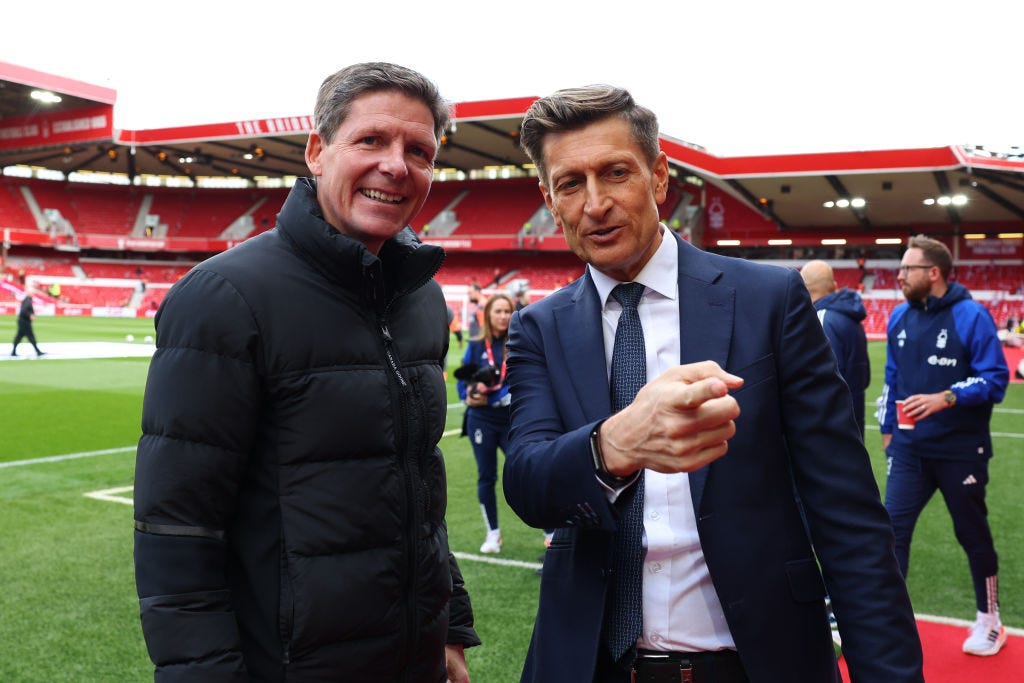
It’s fair to say that these outbursts were very similar to those that saw Nuno Espirito Santo removed from his post as Head Coach early this season, but comparing the two scenarios against each other isn’t really possible. Nuno may have been frustrated at a lack of business initially, but then pivoted to being frustrated seemingly at a lack of control.
There is no doubt that Glasner will be backed with funds and players at Nottingham Forest, and I also don’t see a world where key players are 1) sold from under his nose at late notice, or 2) not replaced immediately.
Glasner’s Formation History & Starts With Clubs
Those of you that have made it this far - you’ll be expecting me to tell you that Oliver Glasner will come into Forest and immediately implement a formation that starts with a ‘3’. And look, you’d be right. All signs point toward this being the formation that Glasner is going to choose.
However, considering all the noise we hear about Glasner, I was very surprised when digging into his coaching history that he has significant experience in using other systems. Everything we hear is how Glasner is married to his back 3 and has no real idea how to coach any other system. That is clearly not true.
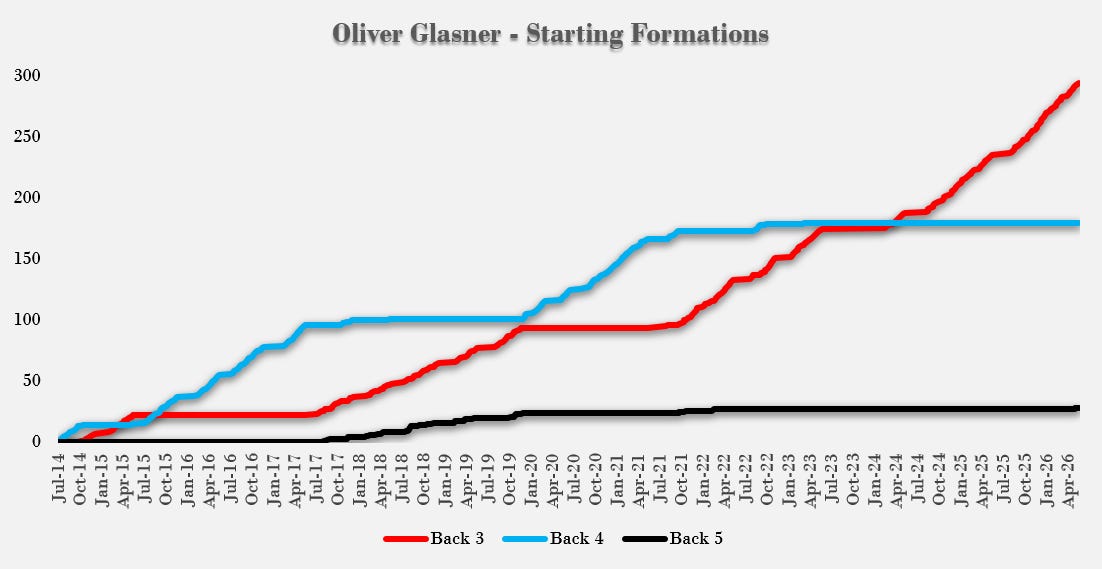
Glasner has been in the dugout for 504 matches according to TransferMarkt - his sides have won 243, drawn 120, and lost 141. We can see Glasner’s starting formation history in the above visual - this shows that it wasn’t until his 6th gme in charge of Crystal Palace where his matches starting with a back 3 went above his total matches starting with a back 4.
Since then, he hasn’t used a back 4 once, and has only gone with a flat back 5 on a single occasion. Glasner hasn’t started with a back 4 formation since a 3-0 away defeat to Napoli in the Champions League back in March 2023 - this was a bit of a hail mary to surprise the opposition in an attempt to overturn a 2 goal deficit from the first leg.
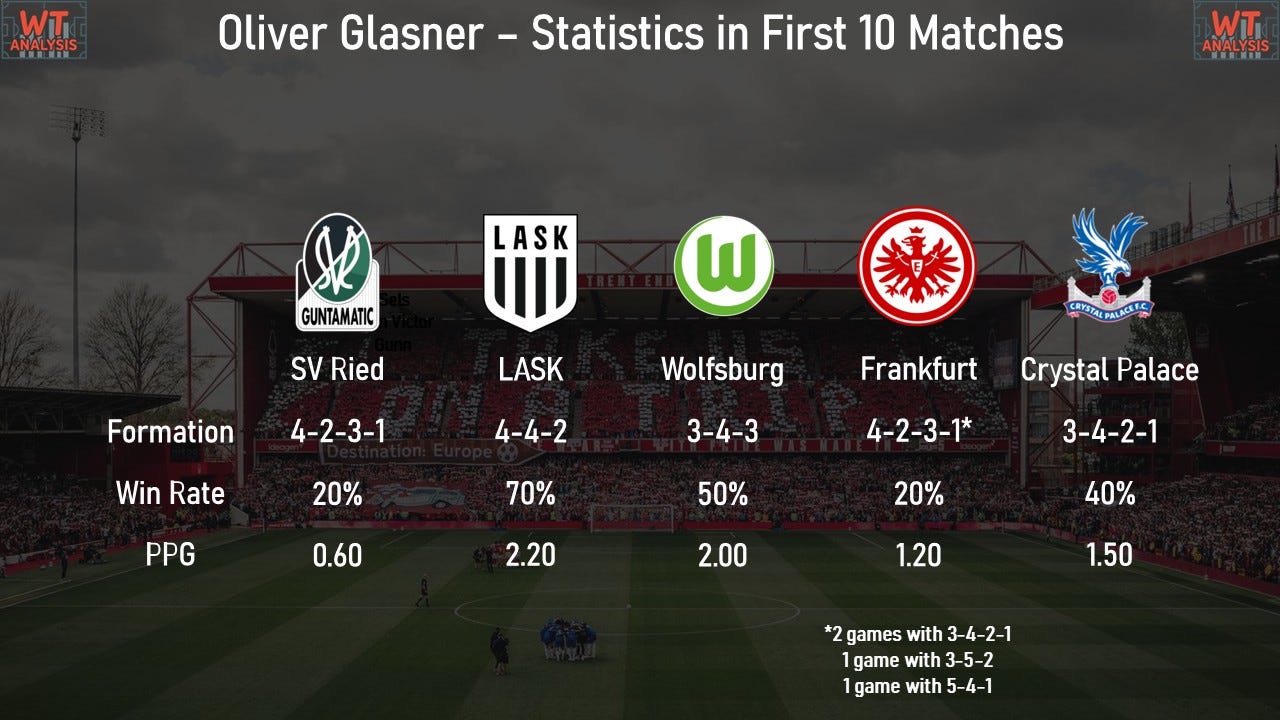
The key info here from a Forest perspective, is that apart from his first role at SV Ried, Glasner has always started reasonably well when taking over a new side. It should be noted that Crystal Palace was the first role he took mid-season, with all of his other jobs giving him time to implement his ideas during pre-season.
His worst start since SV Ried, was with Frankfurt - during which he switched between different formations to try and steady the ship after a poor start. They eventually settled on the 3-4-2-1 that we’ve all seen him use here in England, and obviously went on to win the Europa League in his first season.
These statistics are a good thing - Glasner tends to start well at his new clubs, and I’d guess that if Forest were to start poorly in a 3-4-2-1 that we all expect him to start with, then he would likely roll the dice and flip to a different set up to try and get some points on the board.
Glasner’s Squad Usage
During parts of his time at LASK, and in his spell at Wolfsburg, Glasner has used squads that rank amongst the oldest in the league. Despite his LASK sides average between 24 and 24.5 years old, at one point they were still the 2nd oldest team in the league.
At Wolfsburg, he joined a team that was the eldest in the Bundesliga during his first season in charge. He managed the turnover of the squad into his second season, knocking off half a year from the average age, but they were still the 3rd oldest in the German top flight.
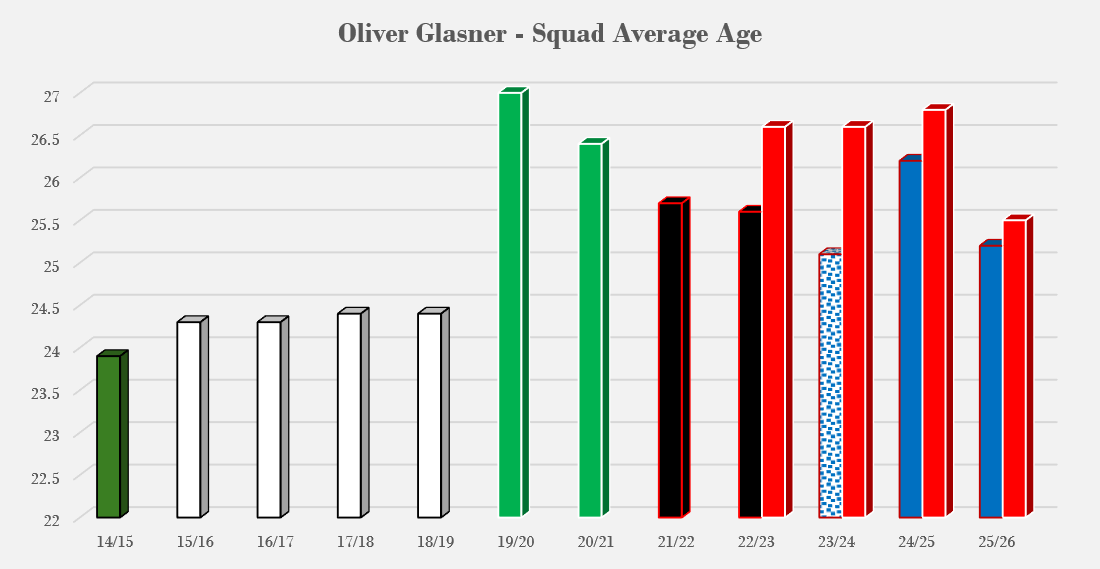
Moving on to Palace, when he joined mid-season the side ranked as the 11th oldest in the Premier League, with an average age of 25.1. He & the club allowed this to increase by over a year going into his second season (that brought the FA Cup), meaning they were the 6th oldest team in the division.
This past season, they knocked the year back off that total and went back down to 25.2 - perhaps with an eye on the congested schedule with European football. This made them the 9th oldest team in the Premier League.
Interestingly, Forest followed a similar pattern last summer, getting significantly younger by taking 1.3 years off their average squad age. This ranked Forest as the 7th oldest team in the league, far lower than their previous positions of 3, 3 & 4 during their seasons back in the Premier League.
Forest’s existing transfer business has seen them get significantly younger already - with the departures of Willy Boly (35), Stefan Ortega (33) & Angus Gunn (30) offsetting the transfer of Elliot Anderson (23).
Perhaps this gives Forest a bit of room to bring in an experienced head or two in the next few weeks - there’s still some gaps within the squad that need to be filled, especially on the basis that the main formation the club will likely use is going to move to a back 3 system.
If you enjoyed this piece, please consider a paid subscription and you’ll receive access to the next parts of this deep dive on Oliver Glasner, as well as all previous posts here on my website. Next up, I’ll be looking at how Glasner’s Crystal Palace perform in different game states.