

For the second consecutive game, Oliver Glasner must have been sat on his sofa when he got home after the game wondering how his Forest side have come away with no points.
The tactical set up - without Forest’s most creative force in Morgan Gibbs-White - was practically perfect. His absence was always going to make it really difficult for Forest to make quick transitions through the thirds, so Glasner asked his side to be very compact, pretty deep, and be far more direct than we’d seen so far this season.
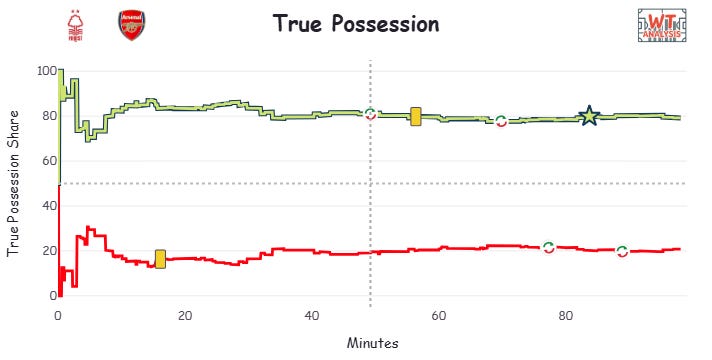
Forest had their lowest true possession share of the season (20.8%), whilst also having the highest long-ball share (the percentage of their attempted passes deemed ‘long’) too, at 30.5%.
Forest were noticeably deep and passive in the opening stages of the game, as they looked to settle in and make sure they didn’t concede an early goal to a side in Arsenal that we know can see out a game once they have the lead.
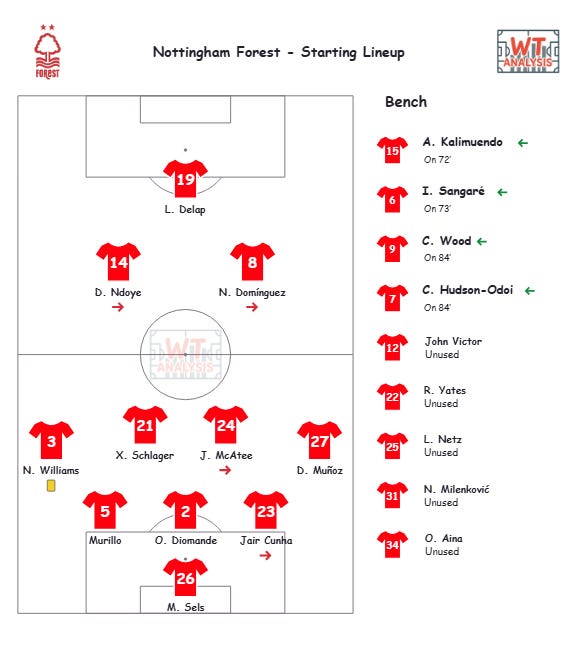
The two ‘10s’ behind Delap have often been very close to the striker and narrow - but on Sunday they were pretty much left and right midfielders in a flat midfield 4 when Forest didn’t have the ball. They stayed narrow, and kept the middle of the field very compact, making it difficult for Arsenal to play through.
Even when Arsenal midfielders would drop deeper, in this game Forest allowed them to do it in those early stages. The centre backs weren’t as adventurous either in the first 10/15 minutes, they were more hesitant to push out of the line, knowing that the narrow midfield block made it difficult for Arsenal to make passes into the gaps between the lines.
As the game went on though, Forest did become slightly more proactive and would try to meet Arsenal a little higher up the field. In this example, we see Forest pushing 6 players into the opposition half, each of them locking onto their own player, apart from Liam Delap.
Here, Delap needs to realise that he needs to block the passing lane to Rice, not Konsa. It sounds simple, but this is an ability that so many strikers don’t have, and is one of Chris Wood’s strengths. Schlager & Dominguez both know what’s about to happen, but Delap doesn’t react and Arsenal play through easily. Forest manage to force them back, and Delap apologises for his error.
Muñoz would constantly look to try and get closer to Calafiori, whilst Williams on the other side stays locked on with Saka. He would also look to pass over Calafiori to Jair Cunha once he moved forward and inverted. As Arsenal advance up the field, Forest do become a bit more lively - the centre backs now almost 15 minutes into the game are more prepared to put pressure on Arsenal’s attackers.
Murillo helps create a turnover that Forest can’t keep hold of, before Forest make another two or three counter pressing options. Having not succeeded with them, the team immediately return to their narrow 5-4-1 shape, which effectively is only as wide as the penalty box. This is incredibly difficult for Arsenal to play through.
This meant Arsenal were forced to make final third entries almost exclusively in wider areas - with only 3 of their 57 entries coming through the heart of the pitch.